Have you ever watched a nature documentary and felt a pang of unease at the violence unfolding before your eyes? Perhaps a lion taking down a gazelle, or a pack of wolves chasing a lone caribou. Is this truly the “circle of life,” or is there something deeper, something more unsettling, at play?
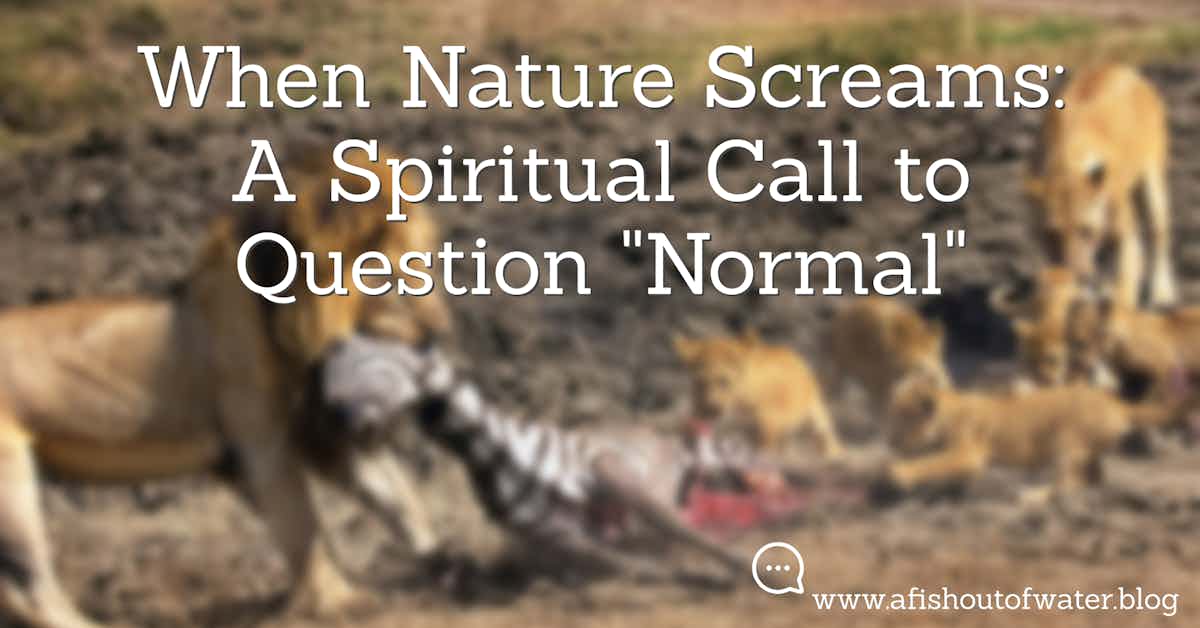
If you seek evidence that this reality falls short of the Father of Lights, look no further than the natural world. A lion’s jaws clamping down on a foal, its mother’s anguished cries echoing through the savanna—this is the stark brutality that some call “nature.” Social media is awash with videos of predators preying on the weak and vulnerable, a spectacle some find entertaining. But how can we find amusement in such terror? How can we dismiss the suffering woven into the fabric of the food chain as simply “the way things are”?
I refuse to accept that this is true nature. This is a distortion, a perversion of the harmony and love that should define creation.
When we view this reality through the lens of the Light, a stark truth emerges: This cannot be the Father’s handiwork. This brokenness may align with the deities of ancient texts, including the Old Testament Bible, vengeful and capricious. But it does not reflect the Father of Lights, the source of all love and compassion, in whom we live and move and have our being.
I recognize that I may be in the minority on this view, but I must wonder, if my spirit is grieved by the scenes portrayed in these wildlife programs, surely so is the Father’s. What happened to us? How did the vast majority of humanity become conditioned to accept that violence and violent death in nature is “natural”? It doesn’t make sense.
Therein, for me, lies another clue that this reality, this system, is flawed, false, untrue. In my view, a system that gradually conditions the vast majority to accept that wrong is right and right is wrong, is suspect! A young child instinctively knows that violence in nature is horrific and wrong; but over time they are conditioned, through initiation rites of passage (in ancient cultures) or gentle persuasion (in Western cultures), to accept it as “normal.” The minority that refuse to be seduced by the lie are dismissed as extremists: “tree huggers,” “vegan warriors,” etc.
For the record, I do not fall into either of those last two categories by any stretch of the imagination. Raised as a meat eater in an environment where we bought live chickens and goats to kill and prepare for food—no sanitized supermarket packaged meat—I grew up used to it, desensitized to it all. While I haven’t eaten meat for several years, I do eat fish. I also handle and cook meat when preparing meals for my loved ones.
Hence, my unease and convictions don’t come from conditioning or a lack of exposure to the blood and gore involved with preparing meat for food. Yet over time, my discomfort grew, along with my unwillingness to accept this violence in nature as the mere “nature of things.”
As my journey of faith and spiritual awakening progressed, so did my inner conviction that what I see in the natural world cannot be an expression of Truth; of the Father’s Light.
The discomfort I feel when witnessing violence in nature is a sign that we are not meant to accept it as normal. It is a call to awaken to a deeper truth, a truth that speaks of love, compassion, and interconnectedness with no contradictions or compromise. It is a hint to the truth that I am not separate from the natural world, but a part of it. To think or believe otherwise, for me, would be to compromise, dilute, or contradict the absolute wholeness and light that I know the Father to be.
Whether by coincidence or design, my body started to feel heavy and uncomfortable on a meat diet. I knew my body was telling me to stop eating meat; so eventually I did. When asked “why?” by friends and family, I cited health reasons. I believe my body knows better what is healthy and unhealthy for it to ingest; and if it is giving me signals that meat isn’t doing me good anymore, then the sensible thing was to stop eating meat. This was true, but not the whole story.
At that point in my journey, I still held the belief that this was God’s creation and so everything in it is “good,” including the killing and shedding of blood in the natural world and the lion preying on the strong, weak, young, and old alike for its food. But I also held the conviction, at the same time, that this wasn’t right. Hence, my meat abstinence was a silent protest to God that I didn’t think this was the best plan.
I knew of the Christian narrative that this all happened because of Adam and Eve’s sin in the garden of Eden. This was not God’s original plan, but with the fall of man, death and violence appeared in creation, including meat-eating and animal preying on animal. This narrative also points to an end-times prophetic word in one of the books of the Torah where the “Lion will lay with the lamb” with no sign of violence or desire to eat it! Presumably, all things were to be restored to the garden of Eden state of existence.
I didn’t buy that narrative then, and I certainly don’t now. I see such narratives, like others, as attempts to desensitize us from the obvious: This reality is not the handiwork of the Father of Lights, whose breath gives life to our being. What I was seeing in nature did not match what I could “see” within me—the witness of the Father.
Perhaps the prevailing narratives about nature being inherently “red in tooth and claw” are part of the distortion. Perhaps there are spiritual or philosophical perspectives that offer a more harmonious interpretation of the natural world. Could the violence we witness be a symptom of a deeper and more sinister truth: that the god and creator of this world we find ourselves in is not the Heavenly Father that Jesus spoke of?
Reflecting on the following words attributed to Jesus:
Luke 6:36: “Be merciful, just as your Father is merciful.”
Gospel of Thomas, Saying 114: “If you bring forth what is within you, what you bring forth will save you. If you do not bring forth what is within you, what you do not bring forth will destroy you.”
I believe it is our responsibility to question the narratives we’ve been taught, to seek a higher truth that resonates with the love and compassion within our own hearts. This is not a call to ignore the harsh realities of the world, but rather to look beyond them, to see through the veil and cloud of religious dogma and conditioning.
As Jesus said, “And you shall know the truth, and the truth shall make you free” (John 8:32).
By seeking this higher truth, we can begin to heal the wounds of separation within ourselves and within the world. We can move beyond the limitations of fear and judgment, and embrace a vision of reality that is rooted in love, compassion, and unity.
 afishoutofwater.blog
Leave a comment